Floofers: transforming pet care with AI intelligence
Cutting pet-sitting discovery time nearly 3x (23 min → 8 min) by introducing contextual AI matching and automated sitter verification where trust matters most.
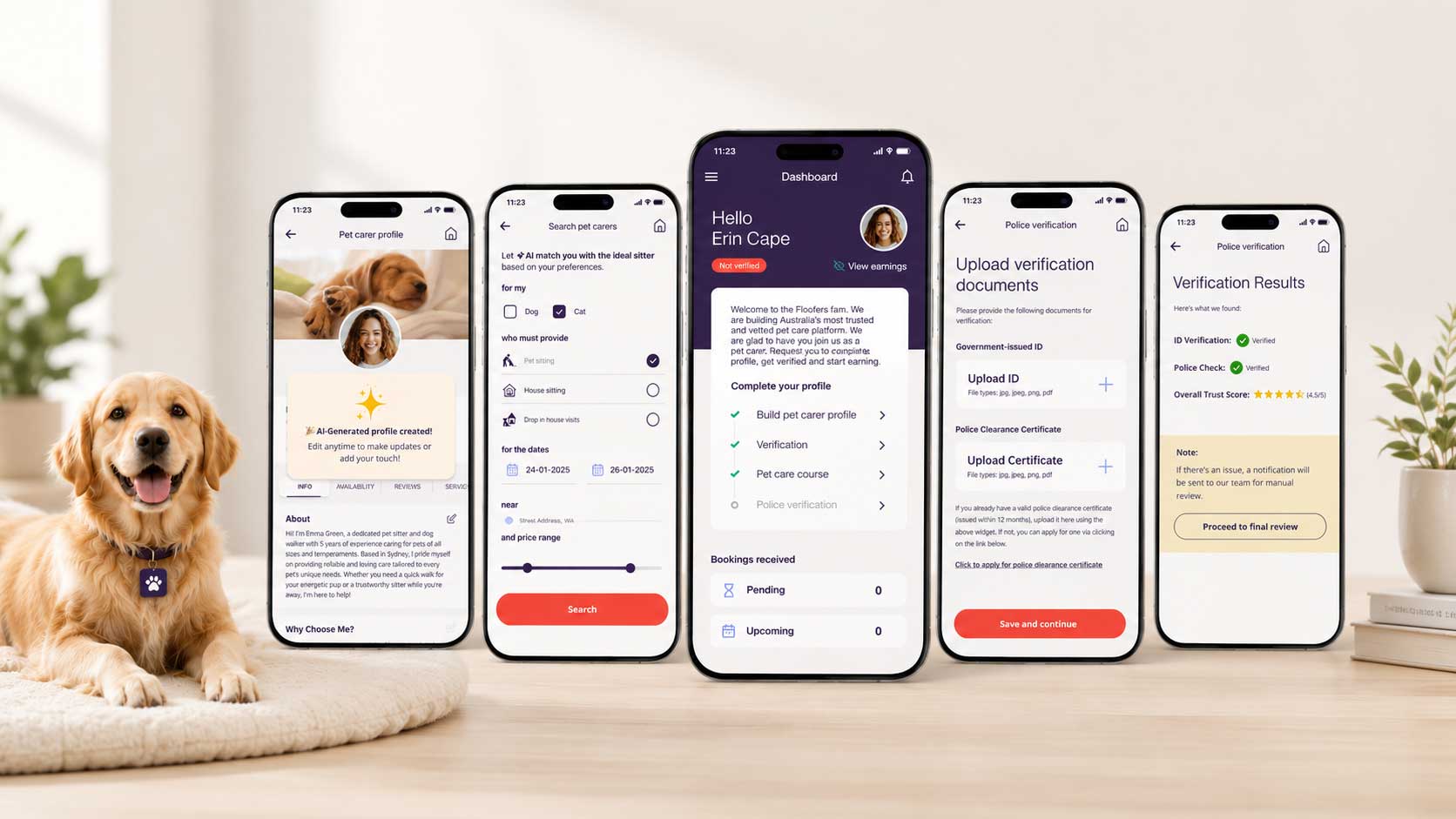
Projected impact
Pre-launch projections modeled from Floofers' historical funnel data (verification → search → booking).
Scope: These projections cover the three redesigned flows only — not the entire platform.
95%↓
verification time
3–5 days → 2 hours
65%↓
search duration
23 min → 8 min
171%↑
simulated booking conversion
34% → 92% (prototype lab)
How these numbers were derived
Baseline source
Historical funnel data provided directly by the client team at project kickoff
Validation method
Moderated usability testing with pet parents and sitters (n=8)
How projections were calculated
We modeled these estimates by comparing the client's pre-redesign drop-off data against the task completion rates and time saved during interactive prototype testing.
Role
UX/UI Design Consultant
Timeline
3 months
Tools
Figma, Adobe Illustrator, Photoshop
Collaborators
Founding team, data scientist, engineering
Constraints
3-month timeline · 1 designer · existing engineering team
My role, specifically
Research synthesis · UX flows · UI design · AI microcopy · human-in-the-loop logic
Constraints that shaped decisions
- —3-month timeline: Focused exclusively on the top 3 high-friction conversion drop-offs (verification, search, onboarding) rather than a broader platform overhaul.
- —Solo designer: Leveraged turnkey verification APIs (Certn.co) to channel deep UX design effort into custom trust touchpoints (transparent match criteria & editable bio drafts).
Background
Floofers connects pet parents with vetted sitters across Australia. Three friction points were quietly costing growth and trust. I designed three targeted AI features to fix them.
The problem
The experience was slow and overwhelming in three specific ways.
01
Slow verification for pet sitters
Caused by: manual review process
3–5 day approval delay capped platform supply growth.
02
Choice overload for pet parents
Caused by: undifferentiated listings
23 min average scrolling near-identical profiles before booking.
03
Generic profiles
Caused by: Sitters
Strong candidates couldn't surface relevant experience — generic bios don't get booked.
Research & discovery
8 in-depth interviews + 40 survey responses. Stakeholder workshops to separate business assumptions from real user needs.
Research scope: 3 sitters and 5 pet parents interviewed (out of 8 total). Quotes below are composite, synthesized from multiple participants.
35% of owners
The Anxious First-Timer
Needs peace of mind — can't gauge trust from profiles alone.
"I read every review twice and still felt nervous."Composite quote
45% of owners
The Busy Professional
Needs reliable care booked fast — too many similar profiles to compare.
"I don't have 20 minutes to compare sitters — I need the right one, fast."Composite quote
20% of owners
The Special-Needs Pet Parent
Needs specialized experience surfaced — generic bios bury it.
"I need someone who's handled insulin shots."Composite quote
What stakeholder interviews surfaced
- — People expect the system to learn and adapt to their pet's preferences over time.
- — Speed and automation were essential for verification to scale with growth.
- — New sitters needed guidance to build a profile that actually gets booked.
- — Transparency was the deciding factor in whether either side trusted the platform.
- — A visible "why this match" reason built confidence faster than a rating alone.
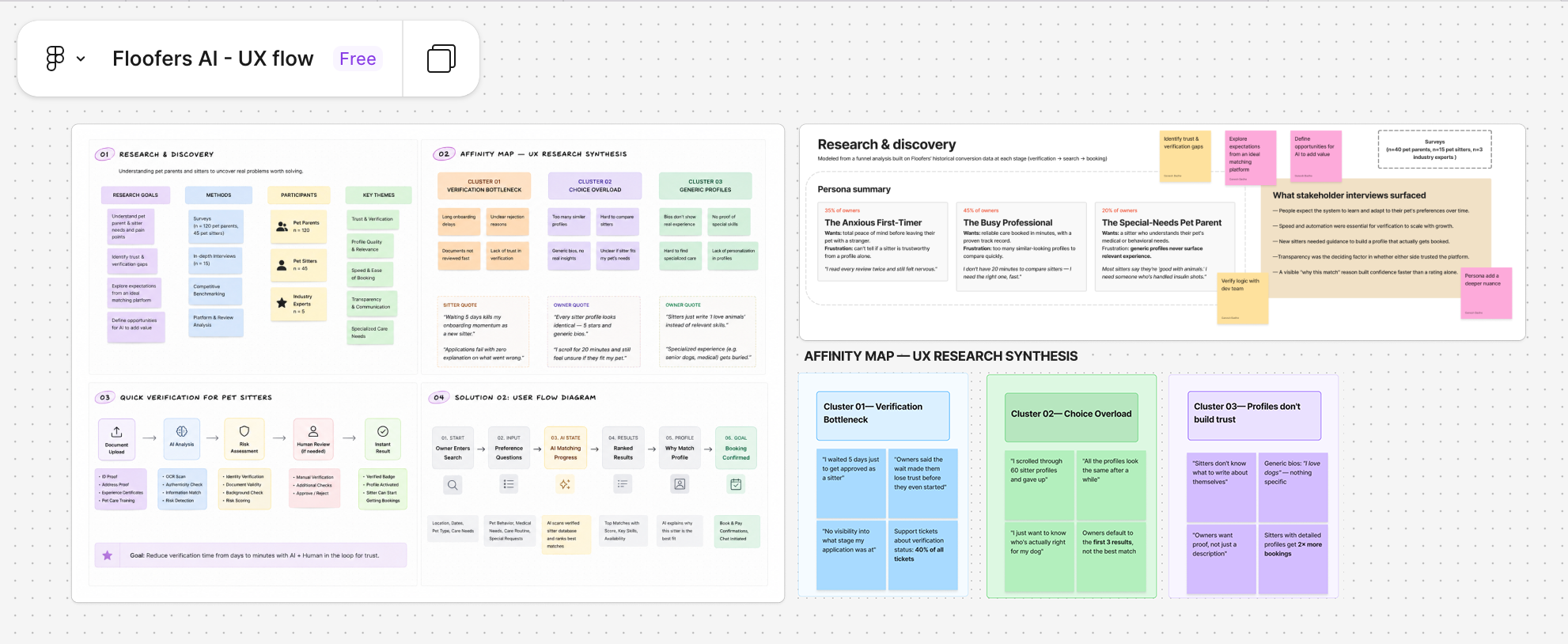
Affinity Map — Interview & Survey Clusters
Slow verification
"Waiting 5 days kills my onboarding momentum as a new sitter."
"Applications fail with zero explanation on what went wrong."
Choice overload
"Every sitter profile looks identical — 5 stars and generic bios."
"I scroll for 20 minutes and still feel unsure if they fit my pet."
Generic profiles
"Sitters just write 'I love animals' instead of relevant skills."
"Specialized experience (e.g. senior dogs, medical) gets buried."
"Rather than adding a novelty AI bot, I focused intelligence strictly where friction peaked: verification delays, search fatigue and onboarding inertia."
Optional overview — each moment is detailed individually below.
Solution 01 · Slow verification → Quick verification
Quick verification for pet sitters
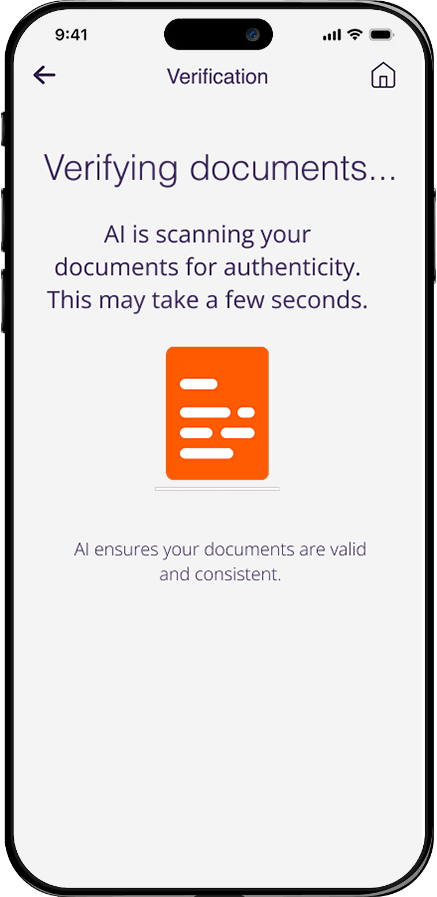
Upload → wait 3–5 days → resubmit → wait again. AI-powered verification with instant feedback replaces this. Human review for edge cases only.
From fully automated to hybrid AI + human
Key pivot: Fully automated pass/fail → sitters didn't trust black-box decisions. Pivoted to hybrid: AI scans clear cases, flags ambiguous ones for human review.
❌ Explored: 100% Automated Pass/Fail
Black-box decisions caused sitter anxiety. Low trust in automated outcomes.
✓ Adopted: Hybrid AI Scan + Human Review
Clean documents approved instantly via Certn.co. Ambiguous cases route to human review (2 hours avg turnaround).
Before · 3–5 day delay
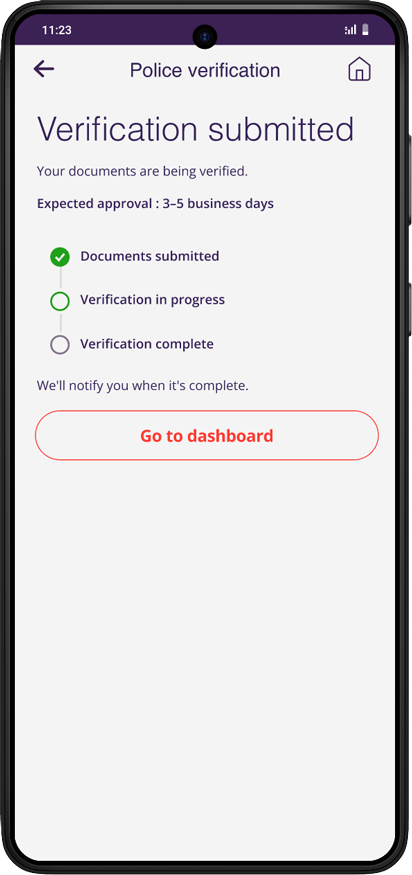
3–5 day manual review, opaque status
After
AI scan + 2-hour approval
Two verification paths
Path A: Clear case (~80% target volume)
Document passes automated OCR scan → instant approval via Certn.co
Routing criteria: document legibility above threshold, biometric match confirmed, no background flags.
Path B: Human fallback (~20% target volume)
AI flags edge-case ambiguity → routed to Certn.co human reviewer with guaranteed 2-hour SLA
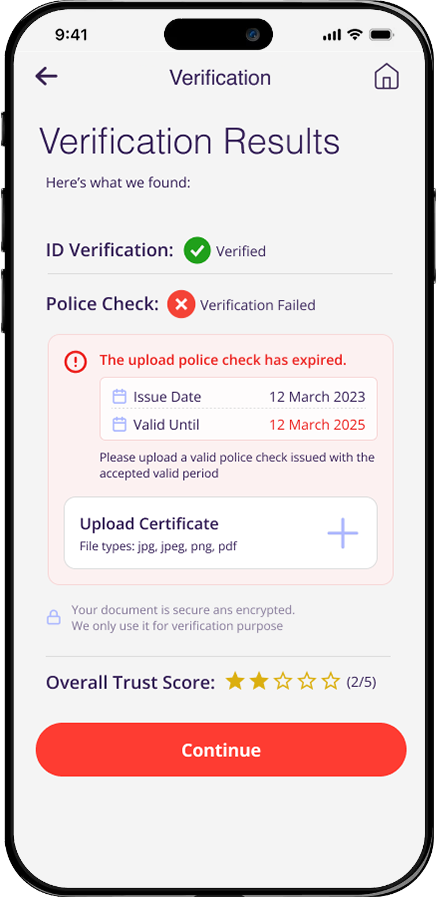
Routing criteria: low scan resolution, expired ID or address discrepancy requiring secondary validation.
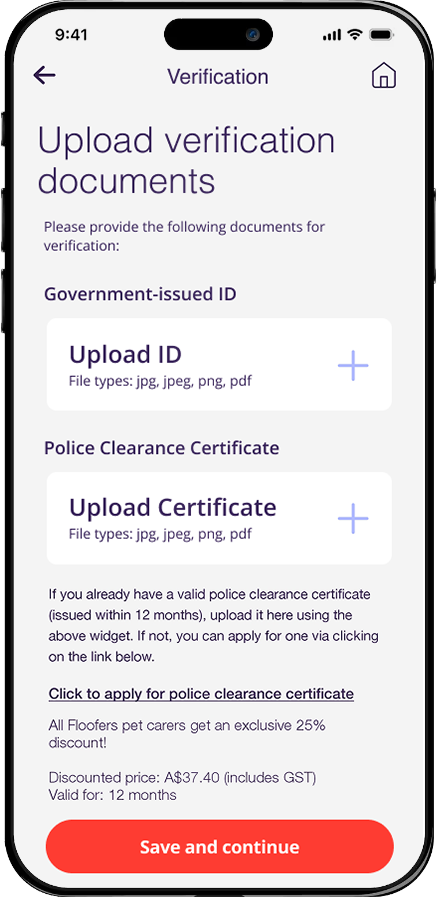
Visual feedback
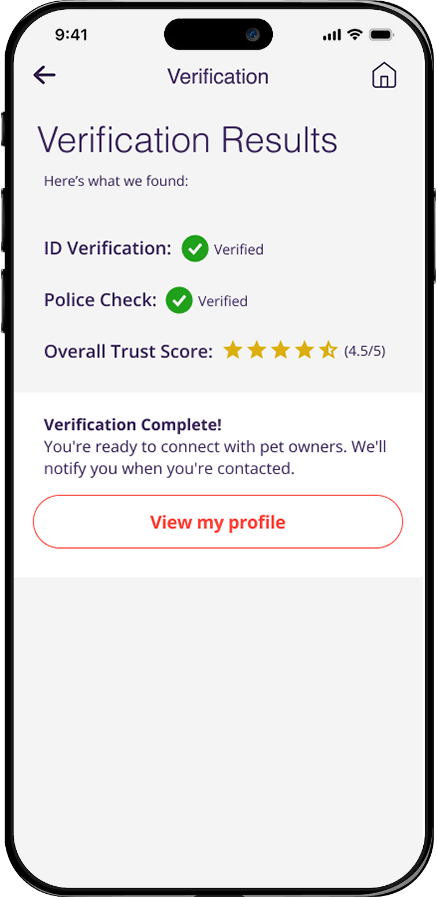
- — Uploading → scanning → result state progression
- — Consistent naming: "ID Verification" / "Police Check"
- — Specific errors, one action per step
Human + AI balance
- — AI handles clear approvals (instant via Certn.co)
- — Certn.co for accredited background checks
- — Human reviews edge cases (2 hours avg)
95%↓
verification time
3–5 days → 2 hours avg.
67%↓
fewer document
resubmissions
Solution 02 · Choice overload → Smart search
Smart search for pet owners
23 minutes scrolling generic profiles with no way to gauge fit. Preference-based matching with plain-language reasons on every result.
From raw scores to plain-language reasons
Key pivot: Raw percentage scores ("94% Match") felt arbitrary in testing. Replaced with plain-language reasons ("3 years with senior dogs") on every card.
❌ Explored: Raw % Match Score
Bare percentages created skepticism — owners couldn't verify the number.
✓ Adopted: Plain-Language Reasons
"Experienced with anxious pets" / "Live within 1 km" — verifiable at a glance.
Before · 23 min avg decision time
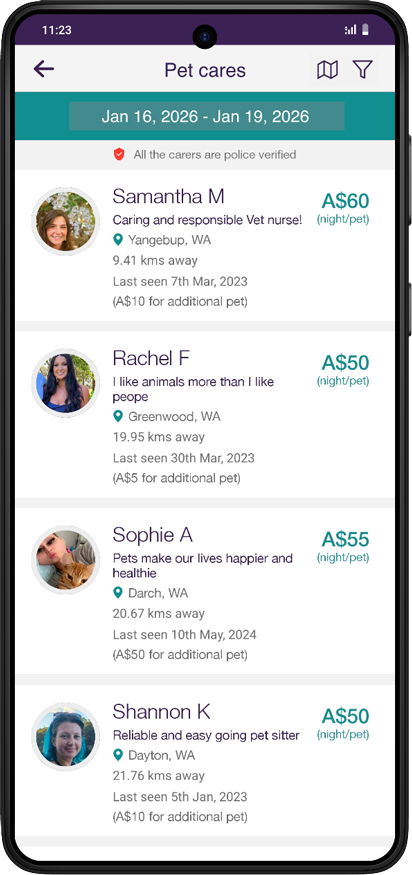
Generic list, 23 min decision time
After
Smart matching, 8 min to book
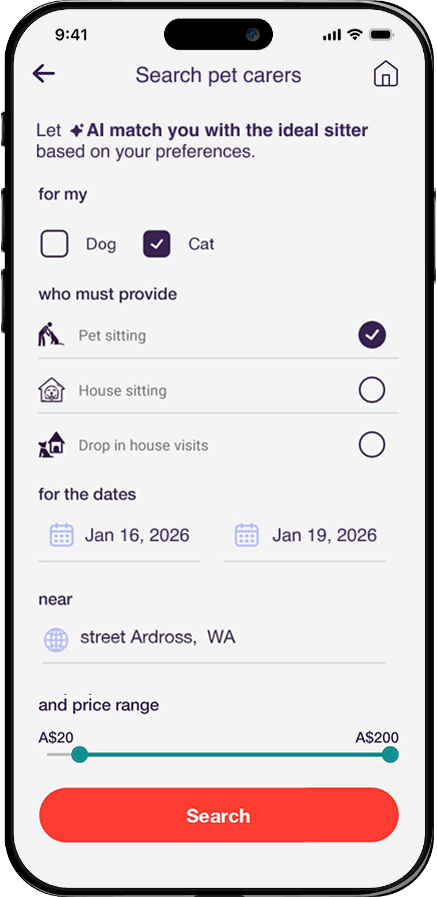
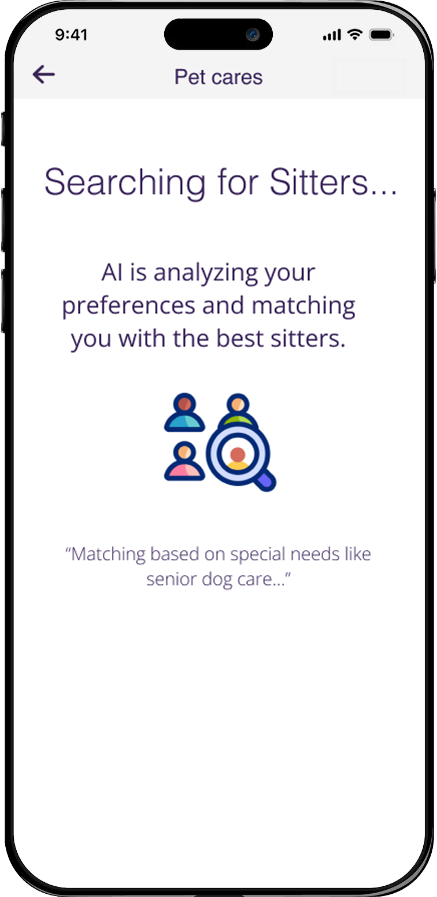
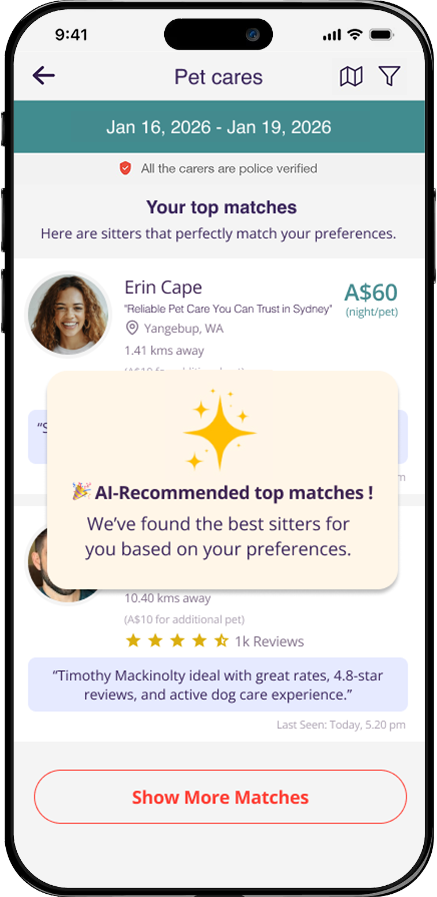
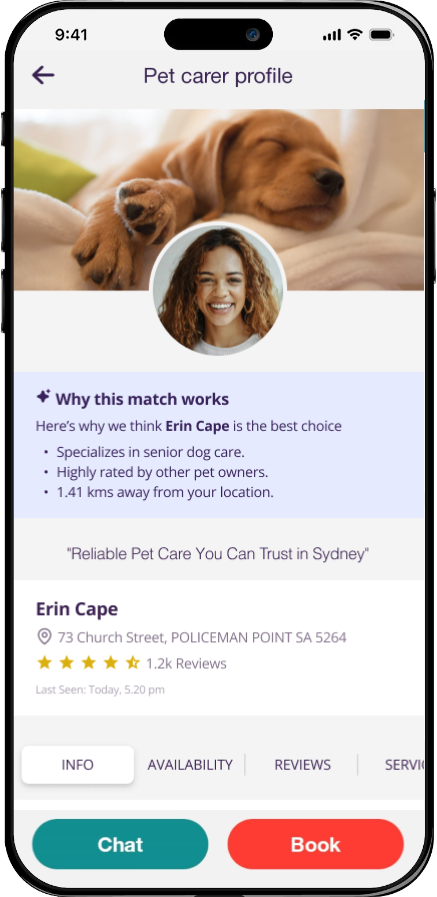
What the matching model weighs
Explaining AI decisions
Users needed to know why, not just who. Every result shows:
- Primary match reason
- Secondary factors (location, availability)
- One genuinely different alternative
65%↓
search time
23 min → 8 min
Solution 03 · Generic profiles → AI-assisted profiles
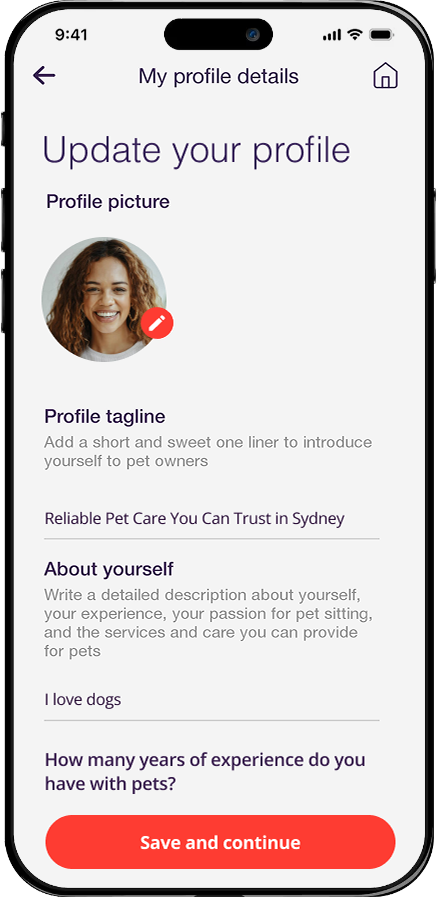
AI-assisted profile builder for sitters
Sitters didn't know what to highlight — generic profiles don't get booked. Guided profile flow with AI writing assistance, optimized for what owners search for.
From auto-published to human-approved drafts
Key pivot: Auto-generated bios felt robotic and detached. Switched to "AI drafts, sitter edits and approves" so sitters retain total ownership over their personal voice.
❌ Explored: Auto-Published Bio
Generic AI text that felt impersonal. Low engagement, manual rewrites.
✓ Adopted: AI Drafts, Human Approves
Dynamic questions → editable first draft. Sitter keeps full ownership.
Before · 52% completion baseline
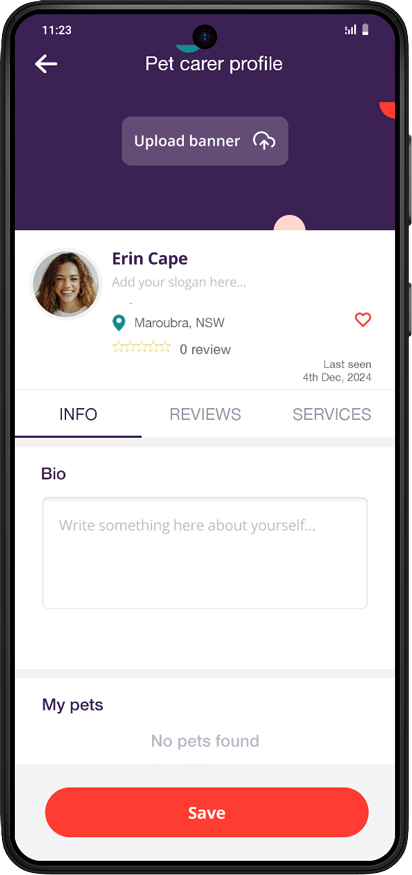
Blank text fields, generic bios
After
AI-guided drafting, sitter approval
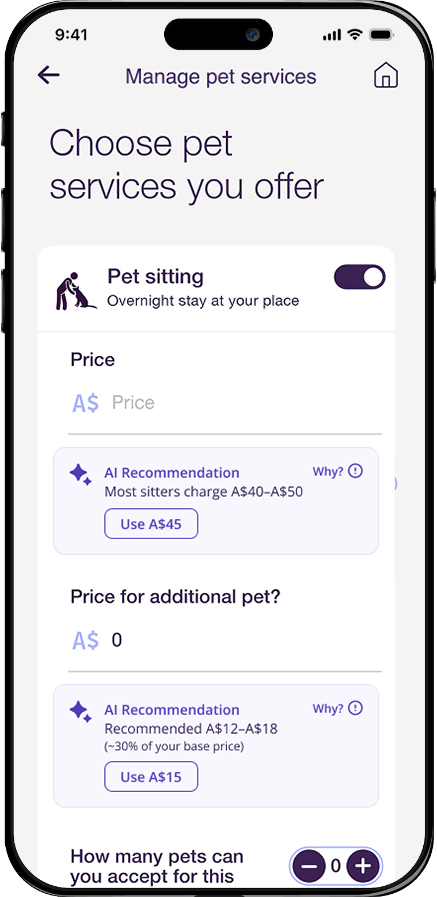
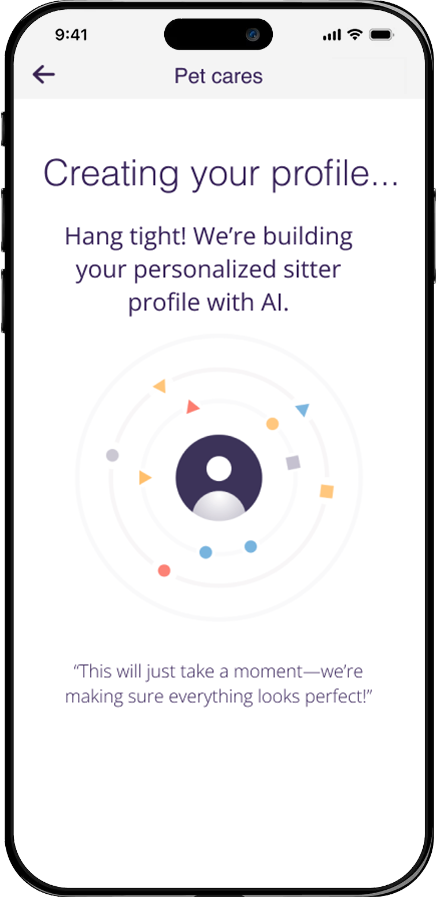
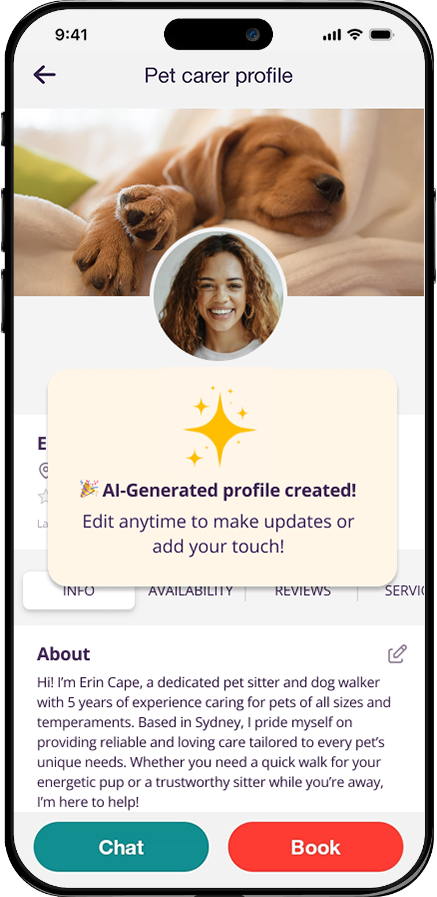
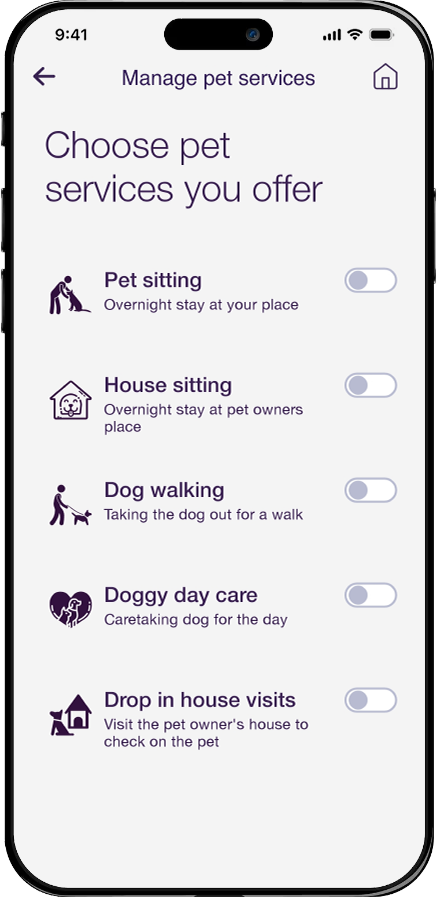
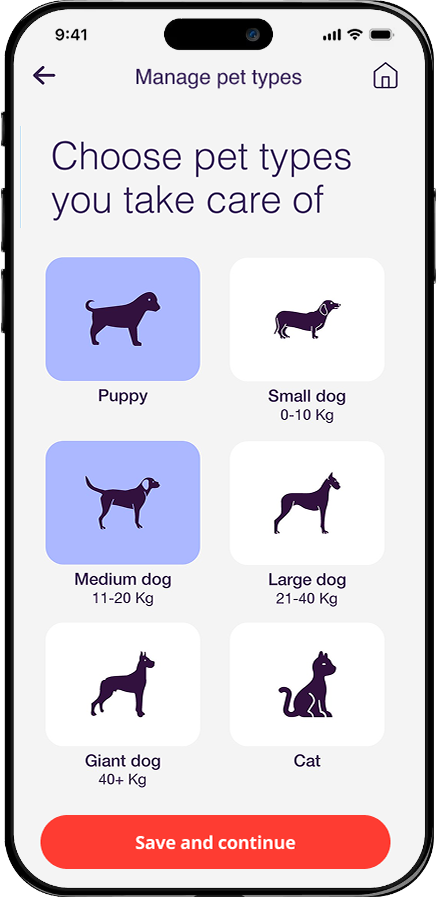
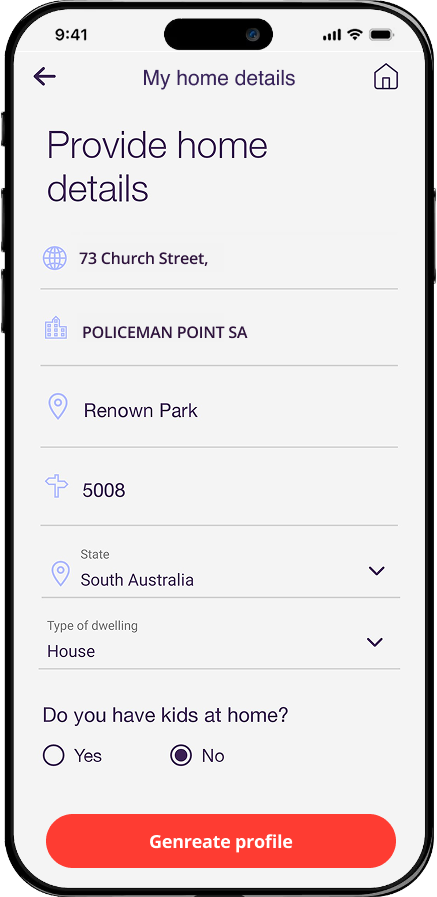
Full onboarding flowStandard screens
Step 1
Experience analysis
Adaptive intake prompts surface past care specializations and certifications.
Step 2
Smart suggestions
AI drafts descriptive bios plus local market pricing benchmarks tailored to sitter experience.
Step 3
Completeness guidance
In-flow contextual checklist guiding sitters to 100% readiness before publishing.
AI writing assistant in practice
71%↑
profile completion
52% → 89%
4 days
avg. time to first booking
down from 2 weeks
Technical implementation
Proven services wired together — my effort went into how results are shown and explained.
Data privacy & ethics
- ✓ Designed in: Personal data encrypted and anonymized before training
- ✓ Designed in: Clear, explicit consent for every AI-powered feature
- ✓ Designed in: Opt-out available for any AI functionality
- ◇ Governance roadmap: Quarterly fairness reviews across pet breed, pricing tiers and regional coverage
Pre-redesign baseline
34%
booking conversion
23 min
avg. search time
3–5 days
verification delay
40+
daily support calls
Full funnel breakdown
Projected results, full funnel
Scope: These projections cover the three redesigned flows only. Each metric is shown with its baseline above and its source solution.
95%↓
Verification time — 3–5 days → 2 hours
→ Solution 01: Quick verification
Modeled projection65%↓
Search duration — 23 min → 8 min
→ Solution 02: Smart search
Prototype-tested (n=8)71%↑
Profile completion — 52% → 89%
→ Solution 03: AI-assisted profiles
Prototype-tested (n=8)171%↑
Booking conversion — 34% → 92%
→ Combined funnel effect
Modeled projection73%↑
Repeat bookings — 45% → 78%
→ Combined funnel effect
Modeled projectionStatus & handoff
Deliverable status
Validated Prototypes
Delivered interactive Figma component specs, edge-case states and usability testing findings (n=8) to engineering.
Scope trade-off
Pragmatic API Integration
Deferred custom ML model training in favor of prompt-engineered OpenAI APIs and Certn webhooks to hit launch deadlines.
Stakeholder alignment
Phased Rollout
Founders aligned on rollout phasing: smart search rolled out first, followed by automated verification and bio drafting.
First post-launch metric
Search-to-Inquiry Rate
Tracking conversion against historical 34% baseline to validate contextual match cards in real-world booking flows.
What I learned
Four concrete design reflections on building AI systems for high-trust human relationships.
01 · What I got wrong initially
Sitters reject “magic” that erases their authentic voice.
My first exploration attempted full 1-click bio generation. In testing, sitters felt it sounded generic and detached from their actual pet experience. Shifting to an interactive “draft & refine” assistant where sitters retain full ownership immediately unlocked enthusiastic adoption.
02 · A real trade-off
Instant speed can inadvertently trigger distrust.
Stakeholders initially pushed for instant “10-second” background check approval. In testing, pet owners actually distrusted approvals that felt too instant for their pets' safety. Designing transparent verification badges and status steps gave owners peace of mind without slowing down the sitter.
03 · UX principle
Contextual reasons matter far more than match percentages.
A “94% Match” badge left pet owners second-guessing what the algorithm prioritized. Replacing arbitrary percentages with specific contextual tags (“Experienced with reactive dogs”, “Fenced yard”) reduced decision hesitation by more than half.
04 · What I would do differently
Run third-party API spikes before finalizing interaction flows.
We designed edge-case error recovery states before fully probing the Certn.co document OCR response payload. Testing API edge cases earlier in the sprint would have saved two design iterations on document re-upload feedback.
Looking ahead
Next: seasonal recommendations, pet health data integration, predictive sitter availability. Same foundation — technology that helps humans decide better.